
These are not my photos, but ones that popped up in my feeds somewhere. They give you a glimpse into where my thoughts and energies are right now.


These are not my photos, but ones that popped up in my feeds somewhere. They give you a glimpse into where my thoughts and energies are right now.

My latest article for Voices of Monterey Bay http://VOMB.org is out. Here are the first two paragraphs.
I’ve been enchanted with the spirit of wild places most of my life. I went backpacking to the top of Mount San Jacinto when I was 9, long before the tram was built. My family and I took a weeklong mule trip to the high country camps of Yosemite when I was 10. We camped every summer when I was growing up. I grew up as a Girl Scout and wild places were very much part of my life. We were taught to pack it in, pack it out, just because … well, what else would one do? Long before there was a “leave no trace movement,” it was what we were taught and what we did.
This upbringing probably contributed to my love affair with Big Sur. It was a natural extension of my wildness education in many of the most beautiful places in California and the West. I learned to water ski on Big Bear Lake and hike in the Sierras. We traveled to Yellowstone, the Grand Tetons, and other wild places of the West. I wish others had the opportunities that I did. Sadly, most of these places are overcrowded and overrun now. The experience is not quite what it was. The wildness is becoming harder and harder to find.
One can find the rest of the article here: https://voicesofmontereybay.org/2019/08/22/the-spirit-of-wild-places/
Enjoy.


I have covered this issue before — last month before the end of the public comment period here: https://bigsurkate.blog/2019/05/16/vacation-rentals-tourism-and-big-sur/ but it comes before the Planning Commission next Wednesday, and I wrote an article for the Voices of Monterey Bay website published today.
Here is part of what I wrote:
“The special characteristic of the Big Sur Coast should also be recognized as a primary resource. Man’s presence along this coast continues to reflect a pioneering attitude of independence and resourcefulness; and the environment has been a special nurturing ground for individual and creative fulfillment. The community itself, and its traditional way of life are resources that can help protect the environment and enhance the visitor experience.” — Big Sur Land Use Plan

By Kate Woods Novoa
Big Sur is raw, rugged, and humbling. It has been said that she can — and will — spit you out, if you don’t belong here. Longtime locals speak of her as if she is an entity. Visitors think of Big Sur as idyllic, and it is in many ways. But this romance does not have a place for short-term rentals.
Those who live here know the difficulties that are a part of the life here: the instability of the road, town trips and school days that must be canceled due to the ever-changing road conditions of Highway 1; storms that take out power lines and telephone lines; slides that take out our main artery, water systems and private roads, not to mention critical bridges; the isolation and the lack of any of the amenities most people have come to not just expect, but need. Get away from the highway, and you may see no services, except what landowners or neighborhoods provide. Here, it is still possible to live up close and personal with Mother Nature. That is why it is humbling. Those who survive the lessons that she has to teach become a community with shared values and a love for this place and one’s place in it.
Fabian Pfortmüller, a Swiss community builder and entrepreneur, defines community “as a feeling of fellowship with others, as a result of sharing common attitudes, interests, and goals.” But community, to me, is more than that. We care about each other, help each other, and care about the places where we live. “This is where the magic of a community happens,” Pfortmüller said. “When people care about each other, they develop trust. And trust unlocks collaboration, sharing, support, hope, safety and much more. While most organizations in the world optimize their performance towards external goals, communities optimize for trust.”
Tales of collaboration, sharing, support, hope and trust are legendary in Big Sur. From the early settlers to the last fire, road closure, or bridge collapse, tales of neighbor helping neighbor abound.
For the rest of my article, please see: https://voicesofmontereybay.org/2019/06/20/big-surs-str-problem/

Representatives of the shuttle service, US Forest Service, Parks Management and others will be there to explain the program and answer questions.
Almost 600 plant species have been lost from the wild in the last 250 years, according to a comprehensive study.
The number is based on actual extinctions rather than estimates, and is twice that of all bird, mammal and amphibian extinctions combined.
Scientists say plant extinction is occurring up to 500 times faster than what would be expected naturally.
In May, a UN report estimated that one million animal and plant species were threatened with extinction. (http://Plant extinction ‘bad news for all species’ https://www.bbc.co.uk/news/science-environment-48584515)
Here are some of the delicate clarkias (wine cups) that face extinction here in Big Sur due to off-roading:
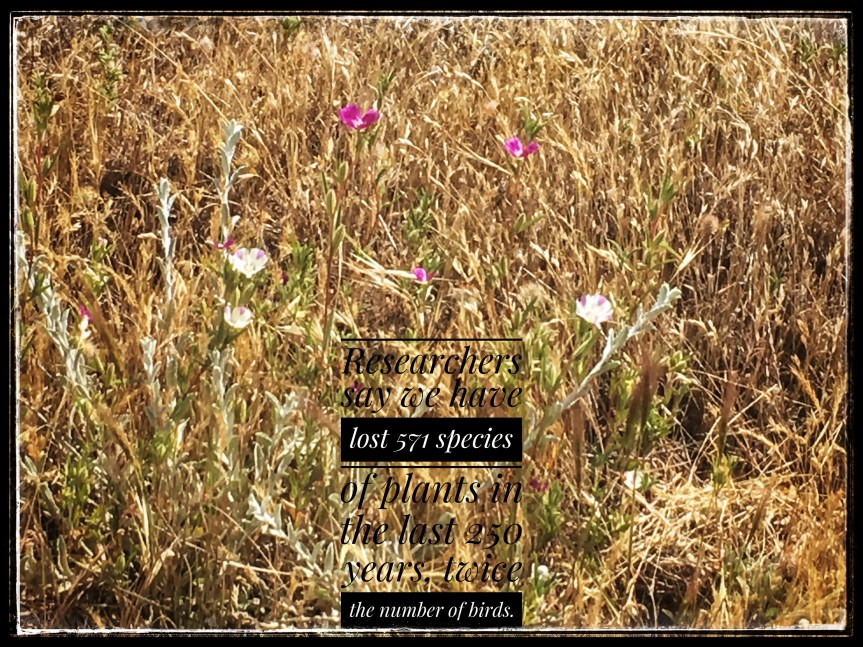

How do these delicate flowers face extinction here in Big Sur? From this:


Public comments sought on draft Environmental
Analysis for Invasive Plant Treatment Program
GOLETA, Calif. – Los Padres National Forest officials today announced the release of a draft Environmental Assessment (EA) for a proposed Forest-wide Invasive Plant Treatment Program. Interested members of the public are encouraged to submit written comments on the draft EA by June 27.
CORRECTION – Los Padres National Forest News Release – We regret the mistake of providing the wrong due date for public written comments – correct date is June 19, 2019
The draft EA evaluates the environmental impacts of implementing a program to control non-native and invasive plants using a combination of mechanical, manual, livestock and chemical treatment methods. With limited capacity to control or eradicate these non-native populations, the Invasive Plant Treatment Program provides necessary tools for improving and restoring native ecosystems and habitat.
Exotic invasive species create a host of environmental effects, including displacement of native plants, loss of habitat and forage, potential loss of soil productivity and reduction in water quantity, as well as a potential increase in the intensity and frequency of wildfires. The program would provide for the aggressive treatment of existing infestations of invasive plants, and would encourage rapid containment or eradication of new infestations before they can become established.
The program is designed with resource protection measures to reduce or eliminate potential impacts to natural resources and the human environment. Following these treatments, restoration actions may be needed to stabilize the area and prevent re-colonization of invasive plants. More information on the Invasive Plant Treatment Program is available on the Los Padres National Forest website at: https://www.fs.usda.gov/project/?project=51845.
Written comments may be mailed to the Los Padres National Forest Supervisor’s Office, Attention: Kyle Kinports, 6750 Navigator Way, Suite 150, Goleta, CA 93117; or hand delivered to the Supervisor’s Office at the address shown above during business hours (M-F 8:00 am to 4:30 pm); or submitted by FAX to 805-961-5729. Electronic comments may be submitted to comments-pacificsouthwest-los-padres@fs.fed.us.
The Monterey District of California State Parks will hold a public meeting on June 6, 2019 to present its’ plan for initial public tours of the Point Sur Naval Facility located within Point Sur State Historic Park.
The purpose of the meeting is to disseminate information and gather public input prior to offering the initial public tours of the facility. The meeting will be held at 10 a.m. at the Big Sur Station, Multi-Agency Facility, 47555 Highway 1, Big Sur.
Questions, inquiries and comments (for those unable to attend) may be directed to State Parks’ Supervising Ranger D.L. Kraft at dkraft@parks.ca.gov.
Mary Trotter sent me this. It was supposed to be noticed in several local media, but she was unable to locate it, so be sure to share this far and wide. Post to FB, twitter, and/or instagram so we can get the word out.

June 6th at 10 am at the MAF Facility (Big Sur Station next to Cal Trans yard.)
“This will be your chance to ask questions and make comments about viewshed issues. Eleven point 4 million dollars of the Prop 72 money went to preserve the viewshed surrounding this facility. It is therefore important that everything be done to prevent the eye being drawn to the blot in the landscape through parking lots, reflections off of cars, crowds of people milling around, additional signs and night lighting.
Self directed tours are being planned, and they speak of a visitor center. Is this what Big Sur needs now in this period of over-crowding, over-use. New easements and new roads are planned – once again in the viewshed. No water is available. Will the new ADA bathroom also be in the viewshed? Please come and get your questions answered.” Mary Trotter
|
||||||||||||||||||||||
|


