
Both Saturday and Sunday, from Cambria to Piedras Blancas, and another though the back country from Cambria to Cayucos.

For additional information and routes, see: Ride routes and general info
Both Saturday and Sunday, from Cambria to Piedras Blancas, and another though the back country from Cambria to Cayucos.
For additional information and routes, see: Ride routes and general info
 |
The California Coast (@TheCACoast) |
|
The April meeting of the California Coastal Commission is Wed. April 10 and Thurs. April 11 at the Monterey County Board of Supervisors Chambers in Salinas. This meeting is open to the public. Agenda and live stream at coastal.ca.gov/meetings/agend…pic.twitter.com/WwvSoeLtR7
|
|
(Continued from Tuesday’s article)
“LC: Absolutely. I’ve been running one of the biggest travel blogs in the world for almost a decade, and about six years I moved to Wanaka, New Zealand. I got there, and I was one of the original people taking photos with my iPhone about this incredible, secret place. Then, over the years, I started to see the influx of photographers and other Instagrammers come, and see the impact of it. So it was very natural self-realization that I had of, “Oh shit, this is my home now and it’s overrun.” Overtourism is right on my doorstep.
So for the past few years I’ve run strategic marketing campaigns with tourism boards and brands around the world and I’ve worked really hard to think about it from a responsible angle as an influencer. So within New Zealand, I almost never talk about where I am, or if I do I talk about it in a very specific or careful way, I’m not going to the truly iconic Instagram hotspots in the country anymore because, for me, it’s not the story that I want to share. It’s not the message I want to share with my followers who are after authentic experiences. What you don’t see on Instagram when you see a photo of a person with their arms in the air on Roy’s Peak, our iconic mountain, is the line two hours long behind it.

ME: Can it be that long?
LC: Yeah. This is a hike that a couple years ago not many people would go up, now I think it’s close to 100,000 a year. A lot of people started to camp up there and it’s not a campsite. There were no toilet facilities, and every Instagrammer was going up there with their tent to take these photos, promoting what is essentially irresponsible behavior. New Zealand has always had this attitude of just behave and be responsible. But how does that work when you’ve got dozens of people camping in a place that no one should camp in? It’s created these dilemmas.
My role as an influencer is to try and think about how I can share this place in a responsible way. Often that means sharing places that are off the beaten path and looking at ways to increase tourism that have a sustainable wildlife message.
ME: Talk about responsibility. You were saying in New Zealand there’s this sense of responsibility. How do you cultivate it in your followers? What comments have you clapped back at?
LC: Basically, I call out irresponsible behavior. I usually send private messages to other influencers when I see them hiking on trails that are closed for lambing season or things like that, just saying hey it’s not a good idea to promote this place when it’s closed. Probably a big one is with drones. I work a lot with search and rescue and helicopter pilots, and people are flying drones all over the place without following the regulations so it shuts down the airspace. It’s just an accident waiting to happen, really. And it interferes with our endangered bird species, so I try and point it out the right way. A lot of people just say, “I don’t care.” But I’m one of those really annoying people—I’ll go up to people on trails and say it.
KAB: That’s really interesting. When you talk to those other influencers, that seems almost more important. The tourism industry used to be based on top ten lists you hoped to be on. Now, top ten lists are based on user-generated content on Instagram. It’s kind of gone backwards. When you talk about the role of media in this issue, creating an ethos of decent behavior is so important.
LC: The past year I’ve been working closely with mountain safety council at the department of conservation trying to encourage more responsible behavior in New Zealand’s backcountry. That’s a big issue, a lot of people who want to go get these beautiful shots but hiking in New Zealand is different from Europe. We don’t have huts everywhere and toilets and people who look out for them. It’s take everything in, take everything out. A lot of these spots are dangerous and off the grid, and you need to take a personal locator beacon. There’s been a massive increase in search and rescue calls funded by us, the taxpayers. When I go out and tell stories about my three day hike in the backcountry, I say, “I’ve brought this, I’ve done this, I’ve prepared this, and it’s this level of difficulty” to try and get that message out there.
ME: It’s like sponsored content but responsible content, showing what you’re taking with you. Cinque Terre in Italy just banned hiking in flip flops because so many people were coming off cruise ships and thought they could do the hike in flip flops and then needed rescuing. I think things like that, showing people you need to pack this, that’s another way. I’m going to throw it out to questions, but before I do I want to ask: who is to blame? It’s easy a lot of the time—Instagram and ‘grammers are the whipping boy for this. Why is this happening?” (to be continued: https://www.cntraveler.com/story/how-technology-can-help-us-tackle-overtourism
From a few years back…

The quote below is by the same woman, Meghan Epler Wood, who wrote the book I introduced last Tuesday. This quote is from her website, EplerWoodInternational, Here
“After decades of steady growth, international tourist numbers surpassed 1 billion for the first time in 2012. The report shows that destinations across the world are not prepared for the unprecedented demands this has placed on them, leading to alarming reports of overtourism. With growth set to continue exponentially, reaching 1.8 billion tourists by 2030, a global crisis is looming.
While overtourism is an important symptom, the use of vital natural, social and public assets without recompense is highlighted as the core of the problem. The report suggests that, wherever it exists, tourism places an “invisible burden” on destinations and their residents. The invisible burden leaves inadequate revenue to provide a sustainable foundation to manage the rapid growth of tourism worldwide.
Examples of the invisible burden of tourism include the costs of:
It’s clear that the failure to properly account for the full cost of tourism growth is preventing action. Therefore, new accounting mechanisms are necessary to protect the very assets on which national economies and businesses worldwide depend.
The report explores innovations in both policy and finance to manage the invisible burden of tourism. It makes a case for public-private cooperation in the design of data-driven mechanisms for managing, monitoring and financing destinations worldwide.
The analysis began with in-depth interviews with academic, business, and global experts and a roundtable at Cornell University. It was followed up with research into current academic and case literature and sustainability studies from relevant fields such as urban planning, protected area management, environmental economics, and the digital economy.
The report will be published in March 2019.”
Closer to home, at CSUMB, Dr. Roberta Atzori and Dr. Laura Kasa are working on a case study on overtourism using as their focus Big Sur and what has happened here. Their case study will become a chapter in a book on this subject. I can’t wait to read both of these reports.
Big Sur Tourism, version 2019 – both taken Friday afternoon, about an hour, hour and 1/2 apart. River Inn & Plaskett Ridge Road.


This is a photograph of a watercolor by Dave Allen, the art teacher at Pacific Valley for many, many years.

The Draft Minutes are 9 pages long, so I will forego publishing them.

Photos 1 and 2 of Mud Creek show grouting the cracks to minimize water intrusion and slide displacement above the roadway looking north. Photo 3: shows Paul’s Slide huge boulder before it’s blasted and 4) Video of boulder blasting at Paul’s Slide.


Today’s Date: March 8, 2019 at 11:30 am
District: 05 – Santa Barbara, San Luis Obispo, Monterey, San Benito and Santa
Cruz Counties
Contact: Susana Z Cruz (bilingual) or Colin Jones
Phone: (805) 549-3138 or 549-3189
FOR IMMEDIATE RELEASE
**UPDATE #3–TRAFFIC ADVISORY**
HWY. 1 AT MUD CREEK TO RE-OPEN BY 3:30 PM TODAY AND PAUL’S SLIDE RE-OPENED YESTERDAY; MUD CREEK MAY INCLUDE TRAFFIC CONTROL
MONTEREY COUNTY — Caltrans has received confirmation from National Weather Service (NOAA) data that the significant storms have passed in the areas of Mud Creek (PM 8.9) and Paul’s Slide (PM 21.6) on State Route 1 in the Big Sur area. Caltrans Geotech, Maintenance Design and Maintenance crews assessed all road areas within the closure limits again earlier today. Contractor and Caltrans crews have been busy clearing slide material, repairing and paving the roadway to make it traversable for public traffic. As a result, Highway 1 at Mud Creek will re-open today, Friday, March 8 by 3:30 pm; Hwy. 1 at Paul’s Slide re-opened yesterday. (See photos attached). Motorists may encounter traffic control at Mud Creek over the weekend.
NOTE: Our maintenance crews will monitor this location over the weekend and notify us if the movement accelerates or site conditions change. In which case, an update will be provided.
Thanks to the Big Sur community and coastal travelers for their cooperation and patience.
Susana Z. Cruz, Caltrans District 5, Public Information Officer
And if you are wondering why Mud Creek is closed? Well here you go: That crack is 5’ deep!
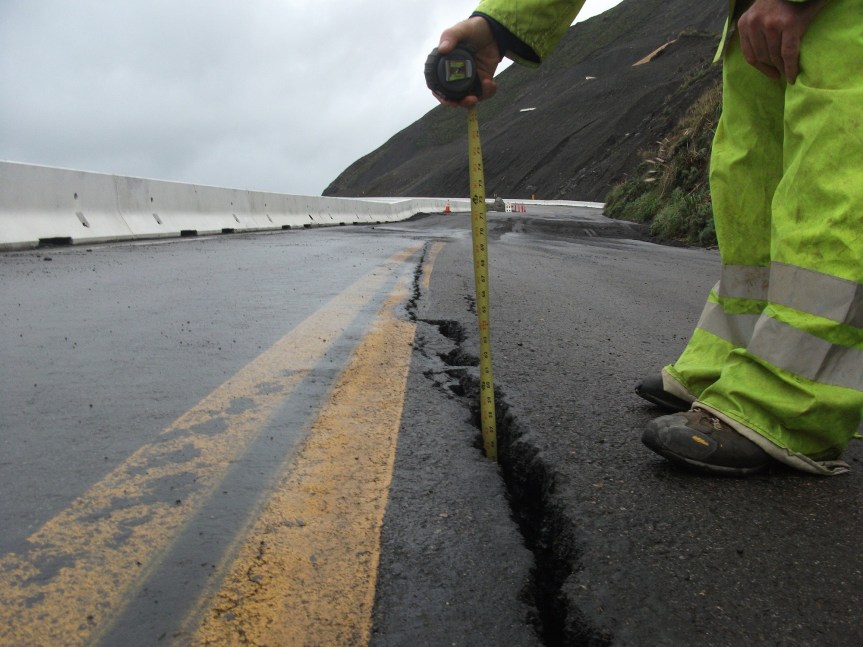
And for another view:

Today’s Date: March 7, 2019 at 12:15 pm
District: 05 – Santa Barbara, San Luis Obispo, Monterey, San Benito and Santa
Cruz Counties
Contact: Susana Z Cruz (bilingual) or Colin Jones
Phone: (805) 549-3138 or 549-3189
FOR IMMEDIATE RELEASE
**UPDATE #2–TRAFFIC ADVISORY**
CALTRANS CONTINUES WITH TEMPORARY CLOSURE OF HWY. 1 AT MUD CREEK, PAUL’S SLIDE RE-OPENS TODAY, THURSDAY, MARCH 7 AT 5 PM
MONTEREY COUNTY —Highway 1 at Paul’s Slide (PM MON 21.6) will re-open by 5 pm today, Thursday, March 7. Hwy. 1 will continue to be closed at Mud Creek (PM 8.9) until further notice.
Businesses along the Big Sur Coast on Hwy. 1 remain open and are accessible via Hwys. 101, 68 and 46.
Caltrans’ Geotech, Maintenance and Construction units are on call — Assessments and cleaning continues at both sites. Crews are currently clearing perched boulders and catchment areas and will have Paul’s Slide open by 5PM today, Thursday, March 7. The movement at the southern conform at Mud Creek has slowed down; paving is planned for the displaced area tomorrow to make it traversable for public traffic. We tentativelyplan to reopen Mud Creek by 5 PM tomorrow, Friday, March 8—dependent on: site conditions, continued displacement, and progress. When Mud Creek re-opens, our maintenance crews will monitor this location over the weekend and notify us if the movement accelerates or site conditions change. Assessments of the roadway conditions and progress will continue to take place in the morning tomorrow, Friday, March 8. Caltrans’ goal is to open the roadway as quickly and safely as possible and our staff remains on-call 24/7. (PLEASE REFER TO PICTURES OF BOTH SLIDE AREAS, AERIAL OF SOUTHERN APPROACH TO MUD CREEK AND VIDEO OF MUD CREEK BOULDER COMING DOWN, ATTACHED).
The gates on either side of Paul’s Slide will re-open at 5 pm today, Thursday, March 7. The gates on either side of Mud Creek will remain closed until further notice. These gates will not be manned when the highway is closed and there will be no access to anyone, including Emergency Services or Caltrans employees until a proper assessment can be made and any necessary cleanup has been completed.
NOTE: This advisory applies only to the Mud Creek and Paul’s Slide areas with each closure being treated separately. Please stay tuned for additional information when the roadway opens again.
An update will be provided by noontime tomorrow, Friday, March 8th.