Pfeiffer Beach Shuttle Service Public Meeting

From and written by Weston Call:

Please join your community At 6:00 PM on Monday May 21st For a round table discussion regarding this summers Pfeiffer Beach Shuttle Survice

A presentation will be given by Weston Call of Sur Transportation.

Ask Questions, Seek Clarification and Learn how the local community is crucial in reducing traffic down Sycamore Canyon by telling inquiring visitors about the Pfeiffer Beach Shuttle.

When is the project taking place? What will the shuttle cost? Where will people park? Won’t a shuttle just add more people to the beach? What about locals? What’s this long term plan I keep hearing about?

These questions, your own, and more will all be discussed Monday night at 6:00pm at your local Grange Hall.

If you cant make the meeting, or have questions that you would like on the agenda, please send them to weston@surtransportation.com

What were they thinking??? 5/12/18

From Rose Welch, who just happened upon this little scenario. Educate our tourists? Perhaps we should start with the tour bus drivers.

D7436405-154F-4306-862B-F2CB51BB9143

From CHP:

6:40 PM 8 [16] B27-P 1185 1097
5:39 PM 7 [13] [Rotation Request Comment] 1039 CALIFORNIA TOW 424-8615
5:36 PM 6 [12] 1185 HEAVY DUTY
5:35 PM 5 [11] 97 / BLOCKING INTERSECTION / 1185 45 FT PASS BUS / ALL PASS ARE OFF THE BUS
5:35 PM 4 [9] [Notification] [CHP]-PER ANOTHER PSRBY, BUS IS HIGH CENTERED AND MULT J PASSENGERS ARE OO BUS ON RHS
5:30 PM 3 [8] B27-P TRAFFIC BACKED UP TO HIGHLAND
5:12 PM 2 [3] MADE A TURN AND NOW STUCK
5:12 PM 1 [2] 1125 NB LN


Succulent Poaching, 5/9/18

Given Saturday’s incident regarding visitors who are poaching our native plants, today’s post is important, but I had to bump it from yesterday’s Tourist Tuesday to today, due to the critical nature of the article I published yesterday.  This issue has already received quite a bit of attention since Jade Davis first contacted me on Saturday afternoon, but you will be seeing more and more of these posters along our coast so that we can become the eyes and ears for protecting Mother Nature just a little more. There is much to do, but each small step we take can be the one that turns the tide. Never give up. Never stop. Continue to care and protect Big Sur.

FEECCECE-69AA-4B0A-B62E-7617603F176A

And from Instagram, a Big Sur local says: “mimihaddad123NATURE IS NOT A COMMODITY: Just because it is in the wild does not mean is up for grabs. Stealing California Native plants is a crime.😡Do not take what is not yours! Grow your own. Think nature over profits.” Be like Mimi. Post this on your instagram account, twitter, FB, or whatever social media you engage in.

Tourist Tuesday, 5/8/18

Surprise: Global Travel is a Huge Contributor to Climate Change

This article excerpt is from KQED, published yesterday. The two articles linked within this one are crucial reading. I urge everyone to take the time to read them. They also directly relate to our situation. Has anyone made the effort to measure the effects of carbon emissions in Big Sur Valley? Or in Monterey Peninsula lately? Are we smothering ourselves in pursuit of more and more tourism? Critical questions.
San Francisco welcomed a record total of 25.1 million visitors in 2016, an increase of 2.3 percent from 2015, according to the San Francisco Travel Association. (Justin Sullivan/Getty Images)

Researchers warn that the surge in global tourism is outstripping the “decarbonization” of tourism-related technology.

In the first study of its kind, researchers found that carbon emissions from world travel contribute about 8 percent of all carbon emissions, four times more than previously estimated.

That rate is expected to grow 4 percent annually, outpacing the footprints of many other economic sectors, according to the study published Monday in the journal Nature Climate Change.

The study takes a sweeping look at the environmental impact of  global tourism by examining the entire supply chain, from flights, dining, to shopping purchases. High-income countries account for the majority of this footprint, with the U.S.  topping the list followed by China, Germany and India.

“Our analysis is a world-first look at the true cost of tourism — including consumables such as food from eating out and souvenirs — it’s a complete life-cycle assessment of global tourism, ensuring we don’t miss any impacts,”  said senior author Arunima Malik, who teaches sustainability at the University of Sydney.

For the rest of the article, see: https://www.kqed.org/science/1923609/surprise-global-travel-is-a-huge-contributor-to-climate-change

Tourist Tuesday, 5/1/18

8BB6EA72-76B0-423A-8487-AD374307AAC3

Venice poised to segregate tourists as city braces itself for May Day ‘invasion’

Metal barriers aimed at separating visitors and locals on key routes into Venice are expected to be put to use on 1 May despite protests by locals against the controversial measure

692066A8-E303-44CA-BB1A-71064BB54583
”I am standing on Venice’s Bridge of Sighs on a Sunday morning … or at least trying to: a tsunami of tourists is flooding towards the Piazza San Marco (St Mark’s Square): people wielding umbrellas or gripping plastic pints of Aperol Spritz, bossy tour guides shepherding cruise-ship passengers, backpacking millennials and many others. So far, so typical, except this weekend – a four-day bank holiday that began on Saturday 28 April and runs to Tuesday 1 May – the city, already straining under the weight of mass tourism, is anticipating record visitor numbers.”
“There needs to be a long-term, organised programme to inform tourists how to behave before they arrive and that should be the responsibility of hoteliers, airlines, cruise ship operators and travel agents. People need to understand and respect the little things that are so important in Venice’s daily life: keeping to the right when crossing bridges, not stopping on the raised walkways to take pictures during Acqua Alta, not littering and not sitting down for lunch on someone’s doorway.”
For the rest of the Article, see:

A Highlands response to the CVA Letter on STRs


There are some serious problems and omissions in the CVA position that will need to be addressed for it to have my support, for example a 4 bedroom home could legally have 2,912 guests per year. And in fact, they could rent rooms by the hour if they wish.
The CVA position is:
No absentee owners, property management companies, corporations, or LLC’s would be permitted. The owner would be required to be a permanent year-round resident, and the home would be his or her primary residence. The owner would be required to live in and be present on site during the short-term rental period. Owners would be limited to no more than one STR. Parking at STRs must be provided off-street for both visitors and residents, fires must be limited to existing barbecue pits, and STRs must be spaced at least 1000 feet from each other.
 
Finally, we wish to point out that STR’s must, of course, be counted as Visitor Serving Units (VSU’s), as defined in the Carmel Valley Master Plan (CVMP). When STR’s are added to other VSU’s, the combined total must not exceed the caps for VSU’s of the Carmel Valley Master Plan. The vast majority of such permissible VSU’s have already been allocated. A count by the organization Host Compliance states that as of April 9th there were “143 unique rental units that fit the STR definition” within the Carmel Valley Master Plan area, 120 of which were “entire homes.” Most, if not all, are unpermitted. This number far exceeds what remains of the Carmel Valley Master Plan VSU allowance. Limiting STRs to home stays would help to bring the number of VSU’s under the Carmel Valley Master Plan limits, which must be done. The Carmel Valley Association requests that the Short Term Rental Ordinance being developed by Monterey County, to be consistent the Carmel Valley Master Plan, include this proposal.
Additional Requirements Needed for My Support:
  • The “Home Stay” cannot be the owner’s principal source of income, nor be the only source of income to pay the mortgage.
  • The owner has to provide some proof they are there during the STR. This can be done by video or some other form of proof posted to a social media site. Otherwise the ordinance is completely unenforceable.
  • The County must do a study on required personnel and resources to enforce the ordinance, and then provide those resources.
  • The limits on Visitor Serving Units under the Master Plan needs to be observed for all areas, including Carmel Highlands and Big Sur. In Carmel Highlands generally there are only 28 additional Visitor Serving Units allowed. Big Sur is also near its limit (300 cap).
  • No rentals of less than one day.
  • The total number of STR guests cannot exceed 2 per the number of permitted bedrooms, less one bedroom for the in-residence owner.
  • No advertising of unpermitted rentals, and Host Compliance or equivalent service is required.
  • Leach fields must be maintained to commercial standards.
  • ADA Compliance (I need to think about this given all the restrictions)
  • Camping STR’s on unimproved land shall also be counted as Visitor Serving Units and subject to the same rules.

STRs – Carmel Valley Letter

The issues and concerns are similar. I suggest that each of you interested in this issue for Big Sur write to the county so concerns are recorded. The Carmel Valley letter does not address the issue of shared private roads and/or easements, which is filled with potential litigation.

CVA Letter to County Supervisors and Planners Regarding Short Term Rentals

Date: April 20, 2018

To: Supervisors, Planning Commissioners, Monterey County RMA Staff
From: Carmel Valley Association
RE: Short Term Rental Ordinance

The following is a supplement to our previous correspondence to you regarding Short Term Rentals:

The Carmel Valley Association strongly recommends that within the Carmel Valley Master Plan area, short-term rentals (STRs) be limited to “home stays.”  “Home stays” are defined as short-term rentals that are owner-occupied and managed. No absentee owners, property management companies, corporations, or LLC’s would be permitted. The owner would be required to be a permanent year-round resident, and the home would be his or her primary residence. The owner would be required to live in and be present on site during the short-term rental period.  Owners would be limited to no more than one STR.

This requirement would minimize the impact of STRs on the housing supply, discourage the conversion of long-term rentals to tourist use, and help address the shortage of affordable, decent, safe, long-term housing for people of all income levels in Carmel Valley.

Residentially zoned areas traditionally permit non-intrusive business activity. Examples of such permitted activities are home offices, bookkeeping services, and music instruction. Such services are conducted by owners or residents who live on the property and generally have a minimal impact on neighborhoods. Allowing non-owner-occupied STRs, which are, in essence, hotels in residential areas, would be inconsistent with residential zonings and would risk significant disruption of quiet neighborhoods.

Many California cities have dealt with this problem.  San Francisco, Santa Cruz, Bishop, West Hollywood, and Santa Monica, among others, have passed ordinances limiting STRs to home-stays. The opinion of the 6tth District Court of Appeal in a case involving the City of Carmel is especially applicable to STRs where the resident owner is not present:

“Such rentals undoubtedly affect the essential character of a neighborhood and the stability of community. Short-term tenants have little interest in public agencies or in the welfare of the citizenry. They do not participate in local government, coach little league, or join the hospital guild. They do not lead a scout troop, volunteer at the library, or keep an eye on an elderly neighbor. Literally, they are here today and gone tomorrow — without engaging in the sort of activities that weld and strengthen a community.”(Ewing v. City of Carmel-by-the-Sea, 234 Cal. App. 3d 1579.)

In addition to our recommendation that STR’s be limited to home stays, for the peace and safety of residentially zoned neighborhoods, we urge that parking at STR’s must be provided off-street for both visitors and residents, fires must be limited to existing barbeque pits, and STRs must be spaced at least 1000 feet from each other.

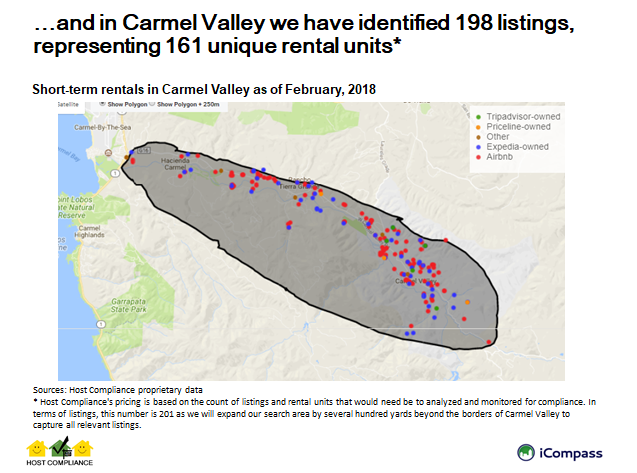
Finally, we wish to point out that STR’s must, of course, be counted as Visitor Serving Units (VSU’s), as defined in the Carmel Valley Master Plan (CVMP).  When STR’s are added to other VSU’s, the combined total must not exceed the caps for VSU’s of the Carmel Valley Master Plan. The vast majority of such permissible VSU’s have already been allocated.  A count by the organization Host Compliance states that as of April 9th there were “143 unique rental units that fit the STR definition” within the Carmel Valley Master Plan area, 120 of which were “entire homes.”  Most, if not all, are unpermitted.  This number far exceeds what remains of the Carmel Valley Master Plan VSU allowance. Limiting STRs to home stays would help to bring the number of VSU’s under the Carmel Valley Master Plan limits, which must be done. The Carmel Valley Association requests that the Short Term Rental Ordinance being developed by Monterey County, to be consistent the Carmel Valley Master Plan, include this proposal.

We appreciate your consideration of our proposals.

Sincerely,

Pris Walton
President, Carmel Valley Association

It is very important that residents of Carmel Valley express their thoughts to the Planning Commissioners.  The draft ordinance and correspondence relating to this discussion can be found by going to the County Website.

Here is the County’s Current Policy (July 2015)

Map of Carmel Valley STRS as of February 2018

STRs

From the Highland STRs group:

The PC staff is having a meeting in Big Sur next week [Tuesday at 9:30 at the Lodge] where they will be recommending/announcing they will be restricting STR’s to “Home Stays”  in a Host’s permanent residence, and only while they are actually living/staying there.  We discussed this in our last meeting, and now the shape of it is better known.  We will need (at some point) to decide whether Carmel Highlands wants to end up with a identical situation.

It is a compromise from the PC’s previous position, and it does accomplish some of what we have been fighting for.  The key things missing are enforcement and ADA. It is not clear where traffic, leach field, water, advertising and other issues end up from our point of view, but it is clearly better than before.  There is also a technical issue on the number of people a Host can rent to because the draft ordinance limit of two times the number of bedrooms doesn’t leave a room for the owner.
On enforcement: responsibility for enforcement shifts entirely to the neighbors from a practical point of view.  The County is substituting an ordinance it won’t enforce, to one it can’t enforce.  On the other hand, fines are way up, and we might have the same legal options we have now (requires legal verification).  And paying a firm for enforcement is cheaper than litigation against the County and Coastal Commission.
I know there are some in our group who have favored this approach, at least in concept. It is also similar to the approach being supported by Carmel Valley.
Please read it carefully when you have a chance, think about it, and let’s communicate our thoughts to each other. (Or in Big Sur’s Case, at the meeting on Tuesday)
There is a bit more info on the website – specifically from Mary Adams office.

Planning Commission Draft Ordinance – “Home Stays” Simplified Explanation

KEY EXCERPTS FROM THE DRAFT ORDINANCE

MAXIMUM OCCUPANCY

No more than two (2) times the total number of bedrooms

Home Stay Definition

There are two different kinds:

A.     The STR unit is the STR Operator’s principal residence, and the STR Operator resides at the STR site while it is occupied by short-term renters.

Planning Commission staff makes the following preliminary recommendation (for Big Sur):

• STRs that are defined as homestays, are consistent with the BSLUP and should be allowed.

• STRs that are to be rented 12 times per year or fewer and not more than 2 times per year (referred to herein as “low-frequency STR”) and: Are a primary residence, are consistent with the BSLUP and should be allowed.

B.     The STR unit is not the STR Operator’s principal residence

Planning Commission staff makes the following preliminary recommendation (for Big Sur):

• STRs that would require a Coastal Development Permit (equivalent to the “Use Permit” in the Draft Ordinance), are not consistent with the BSLUP and should not be allowed.

• STRs that are to be rented 12 times per year or fewer and not more than 2 times per year (referred to herein as “low-frequency STR”) and are not a primary residence, are not consistent with the BSLUP and should not be allowed 

• Un-Hosted Short-Term Rental or Un-Hosted STR: A short-term rental whereby the STR Operator does not reside at the STR site while it is occupied by short- term renters are not consistent with the BSLUP and should not be allowed 

STRs Meeting, Next Tuesday…

…At 9:30 am at the Conference Center at the Lodge.

Important Meeting on Tuesday, April 24th at 9:30 AM 

at the Conference Room at Pfeiffer State Park. 

Mark your calendar, tell your neighbors and friends. 

(if you can’t make the meeting please send an e-mail stating that STR’s are not consistent with the Big Sur LUP to: 
RMA Service Manager Melanie Beretti: BerettiM@co.monterey.ca.us
cc: Supervisor Mary Adams: district5@co.monterey.ca.us and bigsurlcp@gmail.com


A ‘Special Meeting’ to discuss STR’s in Big Sur.

Let’s all show up to demonstrate that allowing STR’s in Big Sur isn’t consistent with our LUP and that the community is close to united in its opposition to making STR’s legal. 


Many of us have testified at public hearings multiple times but it appears that, despite our efforts to clarify the issues, and despite the negative impacts on traffic, public access, housing, public safety and community, there’s still a chance decision makers will make STR’s legal in Big Sur. We need to prevent that from happening.

Again here’s the link to the County announcement of this ‘Special Meeting’

https://www.co.monterey.ca.us/home/showdocument?id=63641

Please share this with your neighbors  (and FB etc!) – it is a very good time to show up and help in the thoughtful protection of the Big Sur coast.

Tourist Tuesdays, 4/17/18

It is hard to write anything for today, after dealing with the Rio Rd. fiasco all weekend, for the second weekend in a row, and also seeing and hearing – loud parties, drunks asleep in the middle of the road, and booming speakers – what people did in my neighborhood. None of what you see below was here a few years ago, and the off-roading was twice as bad on Sunday as it was on Wednesday when I went down the hill to town. So many new tracks and destruction over the weekend. I am saddened beyond belief and my hope in maintaining any semblance of wilderness has been shaken. Soon, all the wildflowers, grasses, and wildlife will be gone.

Tomorrow I will be attending the MCCVB Sustainability Forum, and it will be a challenge for me. I want people who contribute to this madness to be held responsible for the damage. I want those charged with protecting the wilderness, the coast, the highway, and the community to take responsibility. Have we reached the tipping point? Are we past the point of no return?

2D04B363-D1F6-4EB0-81C0-25A8F6D896AA1823DC1F-393A-46D9-9EE0-943136516EA1EED665BB-C2A8-4E44-BB28-B4D900B7F49E3E5D9BDA-7AB5-42F8-AD2C-0CB274D7BF03F836BD71-B2AA-4911-985A-1E858C47824B